

AS1851, AS2419 & AS2118 compliant fire hydrant testing, inspection and servicing for Melbourne’s commercial and industrial properties. Call 1300 475 715 or request a free quote.
What is a fire hydrant system?
A fire hydrant system is a fixed network of pressurised water pipework installed throughout a building or property to provide firefighters and building occupants with direct access to a high-volume water supply during a fire emergency. Unlike portable extinguishers, a hydrant system is designed to supply large quantities of water over sustained periods — making it the primary firefighting tool in commercial, industrial, and multi-storey residential buildings.
In Australia, fire hydrant systems are installed and maintained in accordance with three key standards:
- AS2419.1—Fire hydrant installations (design and installation)
- AS2118 — Automatic fire sprinkler systems (where combined systems exist)
- AS1851 — Routine service of fire protection systems and equipment (ongoing maintenance)
Which buildings require a fire hydrant system in Victoria?
Under the National Construction Code (NCC) and Building Code of Australia (BCA), fire hydrant systems are required in:
- Class 2 buildings (apartments) over 25 metres in effective height
- Class 3 buildings (hotels, motels, boarding houses) of certain sizes
- Class 5, 6, 7, 8 buildings (offices, retail, warehouses, factories) over a specified floor area or rise
- Class 9 buildings (healthcare, aged care, schools, public assembly) as determined by building classification
If you are unsure whether your building requires a hydrant system — or whether your existing system is compliant — AFP can conduct a compliance assessment and advise on obligations under the current NCC.
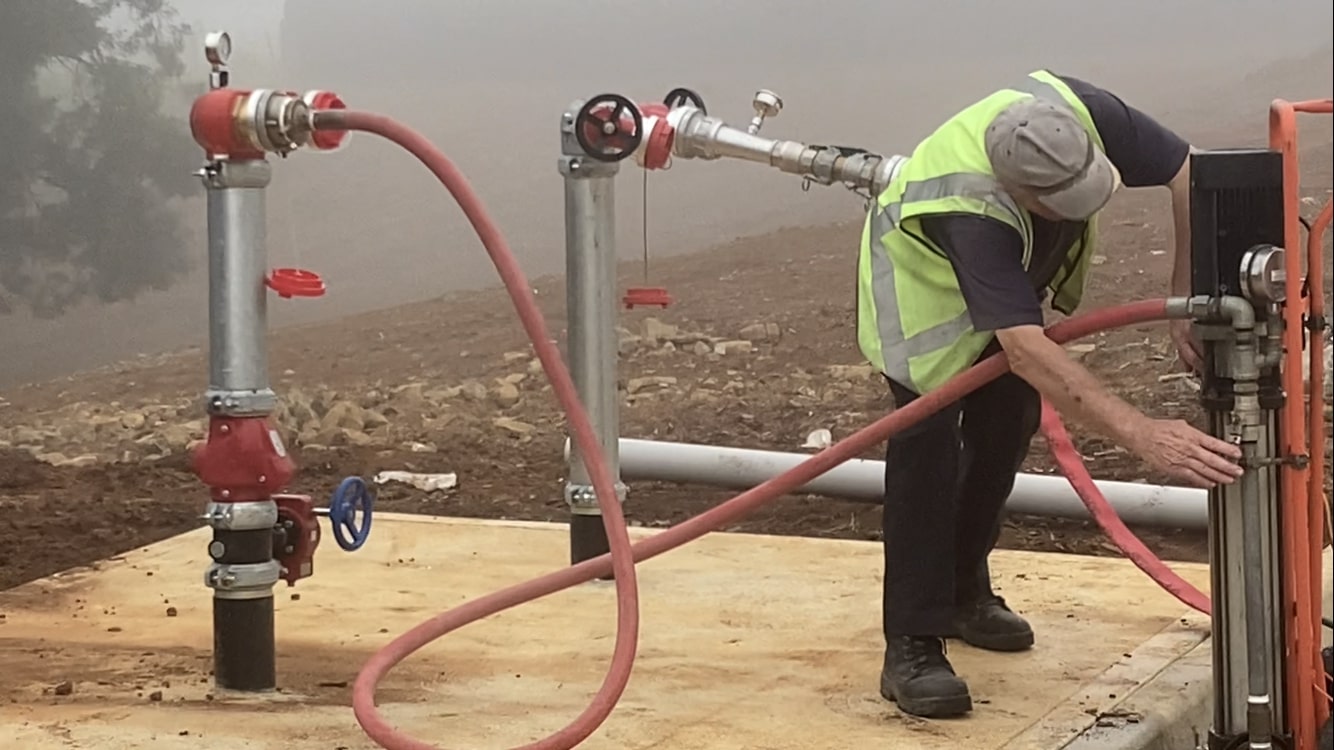
Fire hydrant services offered by AFP
Australia Fire Protection provides a full range of fire hydrant services for Melbourne commercial and industrial properties:
- Hydrant flow and pressure testing
AFP conducts fire hydrant flow and pressure testing in accordance with AS2419.1. Using calibrated pitot gauges, our technicians measure static pressure (non-flowing) and residual pressure (flowing) to verify that the system delivers the required minimum of 10 l/s at 150–200 kPa at the design point. A full test report is issued after every assessment.
- Hydrostatic pressure testing
Hydrostatic testing verifies the structural integrity of the system pipework by pressurising it to 1.5 times the working pressure and holding for a specified period. This test identifies hidden leaks, faulty valves, and pipe degradation that would not be apparent during a visual inspection. AFP issues a signed compliance certificate on completion.
- Hydrant booster testing and servicing
Fire brigade booster connections allow firefighters to supplement the building’s water supply during a major fire. AFP tests booster connections for flow capacity, checks valve operation, inspects signage and access, and carries out overhaul servicing where required.
- Routine AS1851 scheduled maintenance
AFP manages the full ongoing inspection and maintenance schedule for your hydrant system, covering monthly, 6-monthly, annual and 5-yearly tasks as required by AS1851.
AS1851 inspection and maintenance schedule
AS1851 specifies the minimum routine service requirements for fire hydrant systems. AFP manages this schedule on your behalf:
| Frequency | Inspection / Test Required (AS1851) |
| Monthly | Visual inspection of all hydrant valves, outlets, and indicator posts. Check for physical damage, corrosion, obstructions. |
| 6-Monthly | Functional test of all hydrant valves (open/close operation). Inspect landing valves, test booster connections, check signage. |
| Annually | Full hydrant flow and pressure test (AS2419.1). Hydrostatic pressure test. Booster flow test. Full compliance report issued. |
| 5-Yearly | Hydrostatic pressure test of the entire system pipework at 1.5 x working pressure. Full pipe integrity check. |
AFP provides compliance tracking and sends reminder notifications before each scheduled inspection is due — so your system is never out of compliance.
Why choose AFP for fire hydrant services?
- Active firefighters, sprinkler fitters and licensed industrial technicians on team
- Fully compliant with AS1851, AS2419.1 and AS2118
- Calibrated testing equipment — accurate, defensible results
- Detailed compliance reports issued after every test — ready for Council, insurance and WorkSafe audits
- Based in Thomastown — servicing Melbourne CBD, North West and inner suburbs
- Bundled servicing available — combine hydrant, sprinkler, hose reel and exit lighting inspections in a single visit
Related AFP fire hydrant services
Customers who book fire hydrant testing with AFP frequently combine it with the following:
- Fire Hydrant Hydrostatic Testing — detailed pipe integrity testing and certification
- Fire Hydrant Boosters Melbourne — booster connection servicing and flow testing
- Fire Hose Reels Melbourne — AS1851 scheduled maintenance and testing
- Fire Sprinkler Services Melbourne — combined system inspection and compliance
- Fire Equipment Servicing — full essential services maintenance package

FAQS
What is Fire Hydrant Pressure and Flow Test?
The fire hydrant is a means of accessing the water distribution system in case of fire emergencies. Regular tests ensure that the fire hydrant functions optimally to avoid failure during a crisis. Fire hydrant pressure and flow tests are conducted to ensure adequate water supply to the fire protection system. The property owner is responsible for conducting regular tests of the fire hydrant. The functionality of the hydrant is tested by doing the fire hydrant pressure and flow test at least five times a year.
How is Fire Hydrant Flow Test and Pressure Test Done?
Fire hydrant flow test determines the pressure and the flow of water at any given point in the city’s water distribution system. A pitot gauge is used to test the water pressure by measuring static (non-flowing) and residual (flowing) pressure and water discharge rate in gallons per minute. The Hydrant test equipment is attached to the standpipe to ascertain the force of water. As per Australian standard 2419.1-2005, Fire hydrant installations should have a residual pressure of 150- 200 kPa and a flow of 10l/s.

What is Hydrostatic Pressure Testing?
Hydrostatic Pressure testing is done to ascertain the capacity of the hydrant system to handle pressure at the time of firefighting. The ability of the hydrant system gets impacted by the faulty valves, corrosion, low-quality equipment, and failure of the hydrant system. Pressure Testing is done by filling the unit with water, removing air in the unit, and pressuring the system with 1.5 times the pressure limit and inspecting the system for failures. The specialist will check for any leakages that could be present in the hydrant.
How Often is It Needed to Test the Fire Hydrant System?
As per the requirement of AS1851, one needs to perform five tests annually to ascertain the functionality of the hydrant system under pressure. Professional fire hydrant services like Australia Fire Protection will provide comprehensive fire protection services like regular servicing and examination, hydrostatic pressure test, hydrant booster flow test, and booster flow testing. Our customers are assured of the complete safety and functionality of their fire hydrant system during emergencies.
Who is responsible for maintaining a fire hydrant system in Victoria?
The building owner or occupier (or their appointed responsible person) is legally responsible for ensuring the fire hydrant system is maintained in accordance with AS1851 and the relevant building permit conditions. Failure to maintain the system can void building insurance, breach the Building Act 1993 (Vic), and create significant liability in the event of a fire. AFP can act as your appointed service provider and maintain all documentation on your behalf.
We can help. Give us a call now for your economical quote from Australia Fire Protection. Call 1300 475 715